On the occasion of the 22nd Giornata del Contemporaneo, promoted by AMACI, the Luigi Di Sarro Museum will exceptionally open its doors to the public on Saturday, October 10, 2026, transforming its spaces for an entire day into a place of encounter, listening, and experimentation.
Founded within the Centro di Documentazione della Ricerca Artistica Contemporanea Luigi Di Sarro, active in Rome since 1981, the Museum preserves and makes accessible the artistic legacy of Luigi Di Sarro, combining its permanent collection with the possibility of hosting projects, exhibitions, and events in dialogue with contemporary artistic research. Founded by the artist’s family and celebrating its 45th anniversary in October 2026, the Centre has developed an ongoing programme dedicated to promoting artistic research, education, and dialogue between different languages and generations.
The focus of the October 10 programme will be the theme of the experience of art and its relationship with the public.
During the 2025–26 academic year, the Luigi Di Sarro Museum hosted the Laboratory of Contemporary Arts, Museology, Education and Curatorship, coordinated by Professor Carlotta Sylos Calò and conducted by Dr Barbara D’Ambrosio for students of the University of Rome Tor Vergata, as part of the Contemporary Art History course at the Faculty of Humanities and Philosophy.
On the occasion of the Giornata del Contemporaneo, the students participating in the Laboratory will present the work they developed over the preceding months, starting from a reflection on accessibility and mediation and exploring the relationship between Luigi Di Sarro’s work and the spaces and heritage of the Centre named after him.
The outcome of the Laboratory will not be a conventional exhibition, but rather a genuine participatory visiting experience: the students themselves will welcome visitors and guide them through the Museum, proposing different ways of approaching the artworks, the figure of Di Sarro, and the spaces that preserve his memory.
For one day, therefore, the role of mediation will be placed directly in the hands of a new generation of researchers and future cultural professionals. The visit thus becomes a tool not only for questioning how we look at an artwork, but also who can access the experience of art, through which tools, and with what possibilities for participation.
A day that renews, in the present, one of the original vocations of the Centro Luigi Di Sarro: to make a space dedicated to contemporary art a place open to research, education, dialogue, and the creation of new forms of engagement with the public.
ARP-Art Residency Project is a project conceived and promoted by the Centro Di Sarro, implemented with the support of the Ministry of Foreign Affairs and International Cooperation (MAECI). Now in its 12th edition, it invites young artists to engage with the present through practices that intertwine art, care, technology, ecology, and accessibility.
In an era marked by conflict, climate crises, and radical technological transformation, art becomes a space for listening, connection, participation, repair, and resistance.
The project also reflects on the new cultural sovereignties shaped by artificial intelligence: who produces knowledge, who controls data, and who is excluded by algorithms. In response, a resilient dimension emerges—one that restores value to materiality, manual gestures, and imperfection, understood as forms of resistance against digital dominance.
Furthermore, ARP embraces a geopolitics of inclusion, fostering decentralized narratives and “minor” perspectives that challenge dominant canons. This involves not only dismantling architectural barriers but also removing the cultural, economic, and linguistic obstacles that increasingly render the art world elitist and inaccessible.
Repairing the Present, Imagining the Possible
Six artists, seven encounters, two cities. In Rome and Naples, the twelfth edition of ARP – PACK & GO explores the contemporary through art, perception, artificial intelligence, accessibility, cultural policy and the memory of places.
What does it mean to be contemporary?
This is the question at the heart of HIC ET NUNC n.5 – Repairing the Present, Imagining the Possible, the workshop that forms the core of the 12th edition of ARP – Art Residency Project, the programme of cultural and educational exchanges in the visual arts conceived and promoted by the Centro di Documentazione della Ricerca Artistica Contemporanea Luigi Di Sarro, with the support of the Italian Ministry of Foreign Affairs and International Cooperation (MAECI).
The title HIC ET NUNC, “here and now”, does not simply refer to current events. The contemporary is understood as a critical position: the ability to look closely at one’s own time, recognise its contradictions and transformations, and question the categories through which the present is interpreted.
Within this framework, repairing does not mean reconstructing a previous order, but activating new connections between what has been separated: bodies and spaces, memory and the present, technology and responsibility, access and participation. Imagining the possible, in turn, means keeping the field of possibilities open, recognising art as a space in which what exists can be observed, questioned and temporarily rewritten.
Six artists, six ways of looking at the present
The residency brings together Quentin Bouard, Carmen Buonanno, Clélia Guy Blanco, Henry Kiyingi, Julia Strohmeier and Angela Vareschi — six artists with different backgrounds and practices, connected by their ability to move across languages and questions of the present without reducing them to a single interpretation.
Quentin Bouard, after studying philosophy, works across performance, installation and video. His practice investigates the material conditions and precariousness of everyday life and artistic production, exploring balance, interdependence and the possibility of sharing what Jacques Rancière defines as the “sensible”.
Carmen Buonanno, a visual artist and researcher based in Naples, works across installation, text, textile, performance and site-specific practices. Their research explores language, identity, perception and the body, with particular attention to neurodivergent experiences and alternative forms of communication.
Clélia Guy Blanco, a French-Spanish artist based in Paris, works across sculpture, clothing, weaving and publishing. The possibility of being touched is a recurring thread in her practice, alongside an exploration of the therapeutic and sensory dimensions of textiles and weight.
Henry Kiyingi, a multidisciplinary artist based in Kampala, Uganda, works across painting, textiles, sculpture and recycled materials. His practice brings memory, culture and time into dialogue, combining traditional bark cloth with contemporary materials to explore identity, labour, heritage and sustainability.
Julia Strohmeier, a German artist, works at the intersection of fine arts, cultural studies, migration and education. Her interest in people, ways of thinking and self-reflection translates into practices that seek to stimulate curiosity, participation and discussion.
Angela Vareschi, an Italian artist based in Berlin, explores identity, sexuality and dreams through masks, marionettes and puppets, which she activates through performance. In recent years, she has developed participatory projects in which dreaming becomes a shared space of imagination, resistance and connection.
Six different trajectories that, through encounter, form a collective question about how we inhabit bodies, spaces, memories and relationships today.
A laboratory across disciplines
Around the artists, the workshop creates a map of different fields of knowledge.
The programme of talks moves across art history, neuroscience, artificial intelligence, accessibility, cultural policy, heritage and site-specific practices, bringing together scholars and cultural professionals from different areas of expertise.
The programme opens with Simone Ciglia, art historian, critic and curator and Professor at the University of Oregon, whose contribution examines how international museums construct and transform the narratives through which contemporary art becomes visible and legible, fucusing on a possible decentralized narrative.
The perspective then shifts from history to perception with Mirella Manfredi, Assistant Professor at the University of Zurich and coordinator of the Neurodiversity & Cognition Lab, who introduces a neurocognitive perspective on the experience of art.
Paolo De Gasperis, art historian, professor and Scientific Director of the Digital Department at Museo dei Bambini di Roma, addresses the relationship between artists, neural networks and artificial intelligence, bringing questions of authorship, data, algorithmic bias and cultural sovereignty into the workshop.
The theme of accessibility as an aesthetic, educational and research practice is explored by Barbara D’Ambrosio, art historian and PhD at Università degli Studi di Roma Tor Vergata, while Matteo Piccioni, art historian and officer at the Italian Ministry of Culture, examines the relationship between creativity, cultural projects, institutions and public support for artistic production.
Historical and archaeological heritage then becomes a field of experimentation with Giulia Bordi, art historian and professor at Università Roma Tre, whose contribution focuses on video mapping, accessibility and augmented heritage at Santa Maria Antiqua, in the Colosseum Archaeological Park.
In Naples, finally, Alessandra Troncone, art historian, curator, researcher and professor at Accademia di Belle Arti di Napoli, leads a talk and curatorial laboratory on site-specificity and the reimagining of the past.
The seven encounters follow a trajectory that moves from the construction of narratives to perception, from technology to bodies, from accessibility to cultural infrastructures, and from heritage to the memory embedded in places.
Not a series of separate lectures, but a framework for exchange through which the artists can place their practices in dialogue with different forms of knowledge.
Two cities, two moments of restitution
The research developed during the workshop will lead to two public moments of restitution, in keeping with the philosophy of ARP – PACK & GO, which considers the mobility of artists, artworks and ideas as an integral part of the process.
ROME
30 September 2026 · 5–8 pm Centro Luigi Di Sarro Via Paolo Emilio 28, Rome Free admission
The first public presentation will take place in Rome, bringing together the outcomes of the artists’ research and workshop process. The Centro Di Sarro/Museo Luigi Di Sarro becomes a space for encounters between practices, materials, reflections and processes developed during the residency.
NAPLES
3 October 2026 · 11 am WHITESPACES Projects/Napoli Free admission
The project then continues in Naples, where moving from one city to another becomes part of the curatorial structure itself. The works and practices are not simply transferred, but reactivated through a new context.
Mobility thus becomes a way of reading. Changing place means changing perspective, relationships and possibilities of interpretation.
HIC ET NUNC: the present as a field of research
With HIC ET NUNC n.5, ARP continues its investigation into the meaning of the contemporary, bringing emerging international artists into dialogue with scholars, curators, institutions and cultural sites.
The workshop approaches the present not as a surface to be represented, but as a complex territory to be explored.
Art, care, technology, accessibility, memory, institutions and space become different entry points into a research process that does not seek a definitive answer to the question “what is contemporary?”, but creates the conditions for asking it again.
Because perhaps repairing the present means, first of all, learning to look at it from more than one position. And imagining the possible means allowing those positions to enter into relation.
For the 21st Gdc, on October 4, 2025, the Luigi Di Sarro Museum will have special opening hours: morning hours from 10 am to 12:30 pm and afternoon hours from 4 pm to 7:30 pm.
The Luigi Di Sarro Center for Documentation of Contemporary Artistic Research, founded in Rome in 1981 following the artist’s sudden passing, has been a point of reference for emerging and experimental art for over 40 years. Today, to enhance its role as a place of contemporary art, it is being expanded as a private museum and permanent collection space. Its rotating displays will be open to dialogue, allowing the public to experience the work of Di Sarro, who worked in the 1960s and 1970s, embodying with full conviction the spirit of informed, forward-thinking, interdisciplinary and multimedia research.
The Center’s four exhibition spaces—which to date have hosted over 400 solo and group exhibitions by emerging artists—display a first selection of works that showcase Di Sarro’s research and method.
A method continually torn between scientific practice and pure imagination, the need for reality and the desire for fantasy, that guided all of Di Sarro’s speculative research and artistic practice, consigning to the duty of memory a weighty mass of works that continue to demand a voice. “My works of art will be like swords that will conquer. The new forms for the world of tomorrow,” the artist wrote in January 1971, and later also “If art accompanies my life. If my life serves art. I… can even die” (February 1978). He died a year later, in February 1979, at just 37 years old. In his studio remain sheets, notes, images, and texts already drafted from what was to become his “Manual of Artistic Anatomy,” his Discourse on Method. This museum aims to perpetuate his epistemological, artistic, and aesthetic legacy.
TGR LAZIO – 4 ottobre 2015 h.14,00 – servizio di Antonella Pallante
What does contemporary art mean and above all how (and to what extent) does the definition of contemporary adapt to the continuous change of time and history? What relationship does the creative idea maintain with the historical, social and environmental context? With the present, past and future? The new edition of the Arp itinerant training residency will delve into the notion of White Cube, or the idea of exhibition space.
ARP-Art Residency Project is a cultural and training and exchange programme in the field of visual arts, now in its 11th edition. The programme is conceived and promoted by the Documentation Center of Contemporary Artistic Research Luigi Di Sarro, with the contribution of Ministry of Foreign Affairs and International Cooperation (MAECI) and other partners, aiming to provide the beneficiaries with an opportunity for training, career development and promotion.
The winners this year are Ludovica Tata as curator, and Monika Milosewski, Xanthe Scout Lardner-Burke, Pierpaolo Perrone, Anna Tappari e Jakub Zawadzki as artists.
The ARP – Pack & GO formula challenges young artists to conceive and create a work that represents its own idea of contemporaneity and is transportable everywhere, in order to allow maximum mobility. The work submitted by each participant was evaluated and chosen by a jury composed of Alessandra Atti Di Sarro, who directs the project, and professors Simone Ciglia and Carlotta Sylos Calò. A young curator was also selected and tasked to work in dialogue with the artists to create the concept for exhibition events.
The heart of this project formula is the Hic et Nunc workshop, conducted by teachers, researchers, curators and art historians. The workshop opens with the revealing of artworks hidden in the physical and emotional luggage of the participants and pushes the group to confront and discuss the most current themes of thought on the contemporary. Over the two weeks of talk, visits and meetings the “giving back” exhibition is born, with its first location at Center Luigi Di Sarro, offering new life and sense to the artworks, according to a multidisciplinary approach and respecting the exchange of ideas, techniques and languages.
Apertura del workshop Hic et Nunc n.4: svelamento e presa di parola
The first location for the public to meet the artists and see the works is then Rome, on 1st October at the h.6 pm with the opening of the first iteration of the exhibition. The Pack & Go circuit will continue with two international events, under the umbrella of the 21st Day of the Contemporary – promoted by Amaci, Maeci and Mic, in Italy and in the world – fully welcoming the theme for the 2025 edition which is “training, understood as a broad and plural process that crosses education, research, exchange of experiences and knowledge”.
Final Exhibition of ARP 11° Edizione at Luigi Di Sarro Museum on 1st Ottobre 2025
“Giving back” exhibitions are unique events of a single evening (or a little more), where the works are presented, inviting the public to enjoy the art and offer a feedback in conversation with the artists. This suggests a path that emphasizes the need for a kind of theoretical and practical nomadism – an approch that keeps contemporary artistic research open to new ideas and opportunities. The second iteration of the exhibition will take place at Kulturno Informativni Centar (KIC) in Zagreb on the 7th of October at 5pm, made possible by the contribution of the Italian Cultural Institute of Zagreb. The final event will follow on 10th October at 7pm at the Turnus Gallery in Warsaw, thanks to the contribution of the Italian Culture Institute of Warsaw.
This year’s Hic et Nunc workshop is conducted by Giulia Bordi, Simone Ciglia, Barbara D’Ambrosio, Matteo Piccioni, Carlotta Sylos Calò and Alessandra Troncone, with the participation of Michaela Limberis in Zagreb and Ilaria Bernardi in Warsaw.
What does contemporary art mean and, above all, how -and to what extent- can the definition of contemporary adapt to the continuous flow of time and history?
ARP returns with a new edition of its training residency to explore the notion of the contemporary. The White Cube will be at the center of the discussion. What relationship does the creative idea maintain with the place in which it is realized? What urgencies or motivations lead the Artist to position themselves inside, outside or beyond the White Cube?Is it the artwork that gives meaning to the space, or the spaces that gives meaning to the artwork?
Are you a young artist or curator with a multidisciplinary approach who is eager to engage with diverse perspectives?
As an artist, do you have the ability to create a work that can travel with you -one that represent your poetics- in an exchange of ideas, techniques and languages?
The exhibition presents Gianna Parisse’s work Mundus Patet, shown for the first time in Italy, an installation composed of different photographic, audio and video elements, which invites us to enter a poetic path of research on the meaning of a place: a house and all that concerns it before and after the Amatrice earthquake of 2016.
The installation inhabits the three rooms of the Luigi Di Sarro Center, with a composition of 171 images of stones collected from the location by the artist; a table, where two display cases containing 342 photographs of glass objects and branches collected from the apple orchard of the house are arranged; a video projection (4′ 43″), whose soundtrack spreads throughout the three exhibition spaces.
The work is composed of fragments aimed at suggesting the dichotomy between the subtle dialogue of man-made elements with elements of nature, and the silent rumbling of the delicate balance between man and nature.
Gianna Parisse’s meticulous work of researching and stitching together the numerous fragments using a portable scanner, a camera and audio recordings, results in an installation that, in its simplicity and essentialism, is immersive and engaging.
The title of the work, Mundus Patet, refers to an ancient Roman festival, which took place every year on the 24th of August at the Palatine Hill and celebrated the world of the dead, but more importantly that which is hidden underground, the soil, the earth. August 24 is also the date of the Amatrice earthquake. The land which embraced the house for many years, the land inhabited by the house, shifts, changes its course, and from a place that welcomes it becomes a place that encompasses it, that reappropriates what has emerged.
The artist’s work restores the intimacy of what has been submerged and investigates the intricacies and veins uncovered by the action of nature on man, and man on nature.
Gianna Parisse artist, architect, PhD, has dedicated herself to the research of the relationship between art and architecture for many years. More recently, she graduated in painting and specialized in graphic arts, particularly in the technology of paper materials, at the Academy of Fine Arts in Rome. She has exhibited in Italy and abroad: Dresden, Germany; Seoul, Korea; and New York, USA.
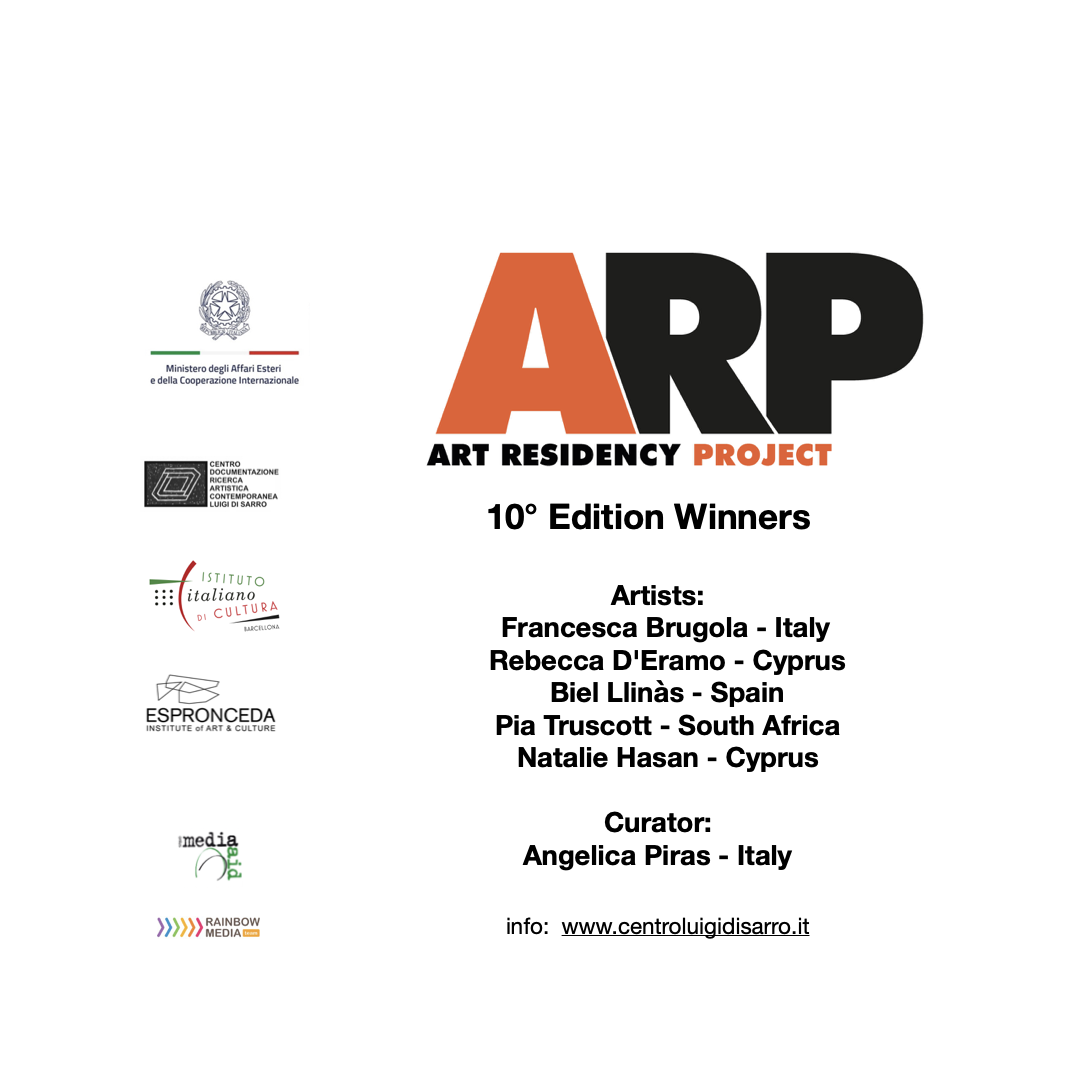
Francesca Brugola – Italy, Rebecca D’Eramo – South Africa/Cyprus, Natalie Hasan – Cyprus, Biel Llinàs – Spain, Pia Truscott – South Africa and in the role of curator Angelica Piras – Italy, are the six young winners who will arrive in Rome to participate in the residency Hic et Nunc workshop n.3 which investigates the concept of contemporary.
They were selected by the jury composed of the Director of ARP Alessandra Atti Di Sarro, the curator, critic and art historian Simone Ciglia and the art historian and professor Carlotta Sylos Calò.
The workshop talk program is an exciting cavalcade between the most discussed themes of contemporary art debate, and will take place with a group of esteemed professors, scholars, researchers and art critics and curators. Most of the programs will take place at Centro Di Sarro and in Museums, archeological sites and other locations in Rome, but thanks to the hospitality of Fondazione Morra Greco the workshop will take the opportunity to have also a stage in Naples.
Return of the residency is the Pack and go circuit which allows the winning artists to show and discuss their work and the curator to create the concept of the events. Thanks to the participation of the Espronceda Institute of Art and Culture and the support and collaboration of the Italian Cultural Institutes of Barcelona, the 10th Edition of ARP, after Rome, will move to Spain with a new show that will fall within the initiatives of the 20th Contemporary Day promoted by Amaci-Mic-Maeci.
The Centro Luigi Di Sarro presents the “POZI” project by the students of the Architecture and Design Course at the University of Cape Town (UCT), which arrives in Rome thanks to the collaboration with the Embassy of South Africa.
On display are the visionary works of the artists who participated in the project, conceived and led by the South African artist Giggs Kgole.
The project, accompanied by Kgole himself, demonstrates not only the skill of these budding architects, but also stimulates their ability to engage in global contexts and artistic expressions.
The collaboration with Giggs Kgole, active internationally, “symbolizes the bridge between local talent and global opportunities”, as Professor Buhle Mathole writes “the students explored and interpreted the essence of Kgole’s artistic world, developing environments that are more than simple work spaces: they are reflections of creative synergy and cultural dialogues.”
Young artists/curators, under the age of 30, from Europe, Africa and the Balkans can participate. Applications by 14 July 2024. Focus of the program, which will take place in September-October 2024, is the Hic et Nunc workshop which delves into the concept of the contemporary with a series of meetings and visits. Return of the residency is the Pack and go circuit which allows the winning artists to show and discuss their work and the curator to create the concept of the events.
Per offrirti un'esperienza di navigazione ottimizzata e in linea con le tue preferenze, centroluigidisarro.it utilizza cookie di sessione. Chiudendo questo banner o scorrendo questa pagina acconsenti il loro impiego. chiudiInfoSettings
Privacy & Cookies Policy
Privacy Overview
This website uses cookies to improve your experience while you navigate through the website. Out of these, the cookies that are categorized as necessary are stored on your browser as they are essential for the working of basic functionalities of the website. We also use third-party cookies that help us analyze and understand how you use this website. These cookies will be stored in your browser only with your consent. You also have the option to opt-out of these cookies. But opting out of some of these cookies may affect your browsing experience.
Necessary cookies are absolutely essential for the website to function properly. This category only includes cookies that ensures basic functionalities and security features of the website. These cookies do not store any personal information.
Any cookies that may not be particularly necessary for the website to function and is used specifically to collect user personal data via analytics, ads, other embedded contents are termed as non-necessary cookies. It is mandatory to procure user consent prior to running these cookies on your website.