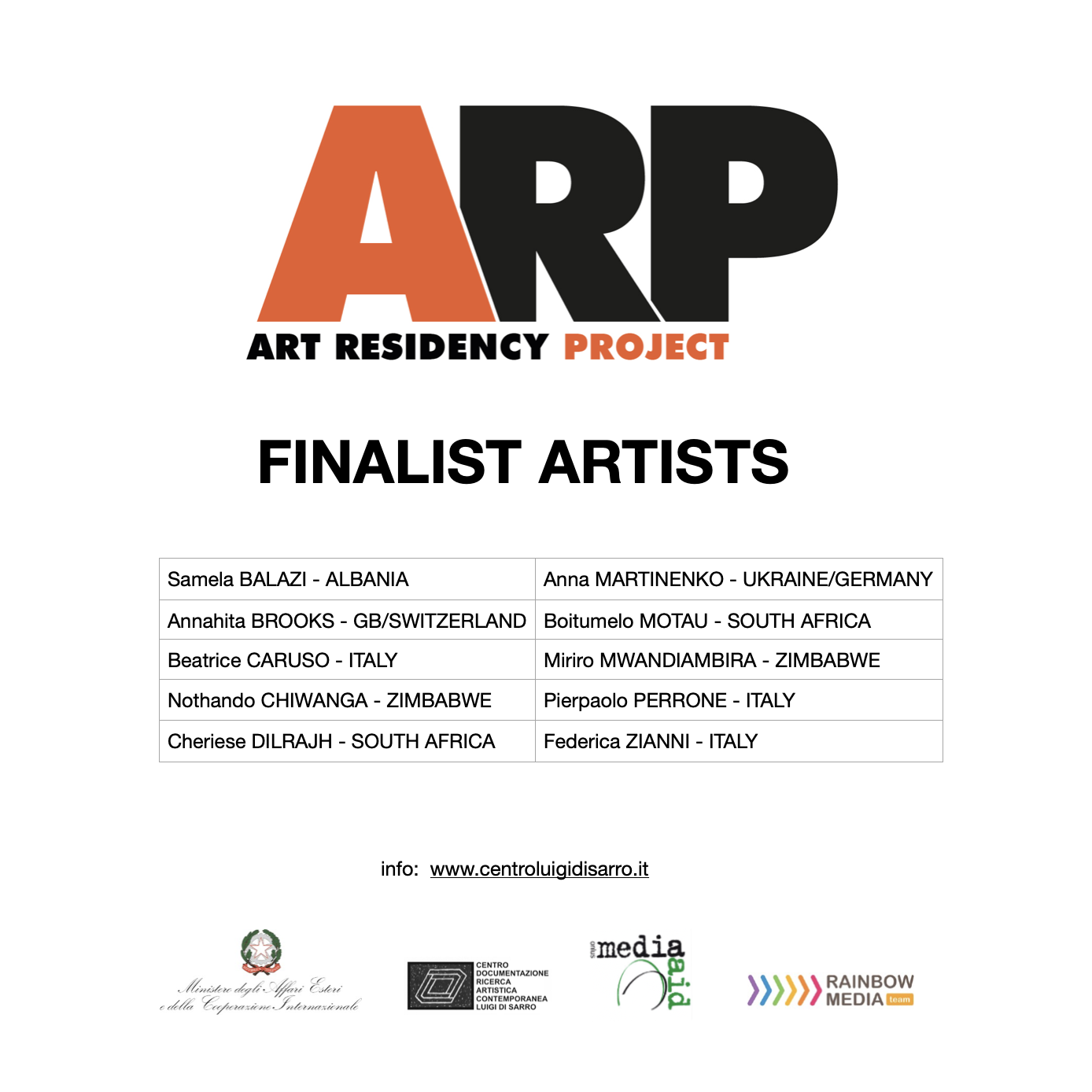
ARP-Art Residency Project is a project conceived and promoted by the Centro Di Sarro, implemented with the support of the Ministry of Foreign Affairs and International Cooperation (MAECI). Now in its 12th edition, it invites young artists to engage with the present through practices that intertwine art, care, technology, ecology, and accessibility.
In an era marked by conflict, climate crises, and radical technological transformation, art becomes a space for listening, connection, participation, repair, and resistance.
The project also reflects on the new cultural sovereignties shaped by artificial intelligence: who produces knowledge, who controls data, and who is excluded by algorithms. In response, a resilient dimension emerges—one that restores value to materiality, manual gestures, and imperfection, understood as forms of resistance against digital dominance.
Furthermore, ARP embraces a geopolitics of inclusion, fostering decentralized narratives and “minor” perspectives that challenge dominant canons. This involves not only dismantling architectural barriers but also removing the cultural, economic, and linguistic obstacles that increasingly render the art world elitist and inaccessible.
Repairing the Present, Imagining the Possible
Six artists, seven encounters, two cities. In Rome and Naples, the twelfth edition of ARP – PACK & GO explores the contemporary through art, perception, artificial intelligence, accessibility, cultural policy and the memory of places.
What does it mean to be contemporary?
This is the question at the heart of HIC ET NUNC n.5 – Repairing the Present, Imagining the Possible, the workshop that forms the core of the 12th edition of ARP – Art Residency Project, the programme of cultural and educational exchanges in the visual arts conceived and promoted by the Centro di Documentazione della Ricerca Artistica Contemporanea Luigi Di Sarro, with the support of the Italian Ministry of Foreign Affairs and International Cooperation (MAECI).
The title HIC ET NUNC, “here and now”, does not simply refer to current events. The contemporary is understood as a critical position: the ability to look closely at one’s own time, recognise its contradictions and transformations, and question the categories through which the present is interpreted.
Within this framework, repairing does not mean reconstructing a previous order, but activating new connections between what has been separated: bodies and spaces, memory and the present, technology and responsibility, access and participation. Imagining the possible, in turn, means keeping the field of possibilities open, recognising art as a space in which what exists can be observed, questioned and temporarily rewritten.

Six artists, six ways of looking at the present
The residency brings together Quentin Bouard, Carmen Buonanno, Clélia Guy Blanco, Henry Kiyingi, Julia Strohmeier and Angela Vareschi — six artists with different backgrounds and practices, connected by their ability to move across languages and questions of the present without reducing them to a single interpretation.
Quentin Bouard, after studying philosophy, works across performance, installation and video. His practice investigates the material conditions and precariousness of everyday life and artistic production, exploring balance, interdependence and the possibility of sharing what Jacques Rancière defines as the “sensible”.
Carmen Buonanno, a visual artist and researcher based in Naples, works across installation, text, textile, performance and site-specific practices. Their research explores language, identity, perception and the body, with particular attention to neurodivergent experiences and alternative forms of communication.
Clélia Guy Blanco, a French-Spanish artist based in Paris, works across sculpture, clothing, weaving and publishing. The possibility of being touched is a recurring thread in her practice, alongside an exploration of the therapeutic and sensory dimensions of textiles and weight.
Henry Kiyingi, a multidisciplinary artist based in Kampala, Uganda, works across painting, textiles, sculpture and recycled materials. His practice brings memory, culture and time into dialogue, combining traditional bark cloth with contemporary materials to explore identity, labour, heritage and sustainability.
Julia Strohmeier, a German artist, works at the intersection of fine arts, cultural studies, migration and education. Her interest in people, ways of thinking and self-reflection translates into practices that seek to stimulate curiosity, participation and discussion.
Angela Vareschi, an Italian artist based in Berlin, explores identity, sexuality and dreams through masks, marionettes and puppets, which she activates through performance. In recent years, she has developed participatory projects in which dreaming becomes a shared space of imagination, resistance and connection.
Six different trajectories that, through encounter, form a collective question about how we inhabit bodies, spaces, memories and relationships today.

A laboratory across disciplines
Around the artists, the workshop creates a map of different fields of knowledge.
The programme of talks moves across art history, neuroscience, artificial intelligence, accessibility, cultural policy, heritage and site-specific practices, bringing together scholars and cultural professionals from different areas of expertise.
The programme opens with Simone Ciglia, art historian, critic and curator and Professor at the University of Oregon, whose contribution examines how international museums construct and transform the narratives through which contemporary art becomes visible and legible, fucusing on a possible decentralized narrative.
The perspective then shifts from history to perception with Mirella Manfredi, Assistant Professor at the University of Zurich and coordinator of the Neurodiversity & Cognition Lab, who introduces a neurocognitive perspective on the experience of art.
Paolo De Gasperis, art historian, professor and Scientific Director of the Digital Department at Museo dei Bambini di Roma, addresses the relationship between artists, neural networks and artificial intelligence, bringing questions of authorship, data, algorithmic bias and cultural sovereignty into the workshop.
The theme of accessibility as an aesthetic, educational and research practice is explored by Barbara D’Ambrosio, art historian and PhD at Università degli Studi di Roma Tor Vergata, while Matteo Piccioni, art historian and officer at the Italian Ministry of Culture, examines the relationship between creativity, cultural projects, institutions and public support for artistic production.
Historical and archaeological heritage then becomes a field of experimentation with Giulia Bordi, art historian and professor at Università Roma Tre, whose contribution focuses on video mapping, accessibility and augmented heritage at Santa Maria Antiqua, in the Colosseum Archaeological Park.
In Naples, finally, Alessandra Troncone, art historian, curator, researcher and professor at Accademia di Belle Arti di Napoli, leads a talk and curatorial laboratory on site-specificity and the reimagining of the past.
The seven encounters follow a trajectory that moves from the construction of narratives to perception, from technology to bodies, from accessibility to cultural infrastructures, and from heritage to the memory embedded in places.
Not a series of separate lectures, but a framework for exchange through which the artists can place their practices in dialogue with different forms of knowledge.


Two cities, two moments of restitution
The research developed during the workshop will lead to two public moments of restitution, in keeping with the philosophy of ARP – PACK & GO, which considers the mobility of artists, artworks and ideas as an integral part of the process.
ROME
30 September 2026 · 5–8 pm
Centro Luigi Di Sarro
Via Paolo Emilio 28, Rome
Free admission
The first public presentation will take place in Rome, bringing together the outcomes of the artists’ research and workshop process. The Centro Di Sarro/Museo Luigi Di Sarro becomes a space for encounters between practices, materials, reflections and processes developed during the residency.
NAPLES
3 October 2026 · 11 am
WHITESPACES Projects/Napoli
Free admission
The project then continues in Naples, where moving from one city to another becomes part of the curatorial structure itself. The works and practices are not simply transferred, but reactivated through a new context.
Mobility thus becomes a way of reading. Changing place means changing perspective, relationships and possibilities of interpretation.
HIC ET NUNC: the present as a field of research
With HIC ET NUNC n.5, ARP continues its investigation into the meaning of the contemporary, bringing emerging international artists into dialogue with scholars, curators, institutions and cultural sites.
The workshop approaches the present not as a surface to be represented, but as a complex territory to be explored.
Art, care, technology, accessibility, memory, institutions and space become different entry points into a research process that does not seek a definitive answer to the question “what is contemporary?”, but creates the conditions for asking it again.
Because perhaps repairing the present means, first of all, learning to look at it from more than one position. And imagining the possible means allowing those positions to enter into relation.